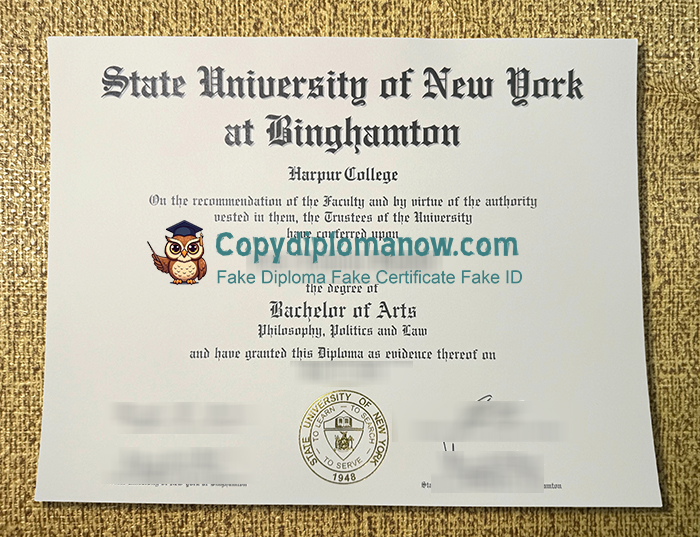
Top-quality Binghamton University Diploma, SUNY Binghamton Diploma, Get USA Bachelor of Arts Degree, Binghamton University (BU) was originally established in 1946 with the purpose of serving local veterans returning from World War II. By 1950, it had been incorporated into the State University of New York, one of four university centres in the SUNY system, which specialised in the liberal arts. It became known by its current name in 1992 and expanded to incorporate graduate and professional programmes.
Comprising seven schools, the university is home to 13,000 undergraduate and more than 3,000 graduate students. It offers a broad, interdisciplinary education with an international perspective, an inclusive outlook, and takes a practical approach to teaching and learning.
Regarded as one of the best public universities in the United States, BU featured among the ‘Top Colleges Doing the Most for Low-Income Students’ according to a ranking by The New York Times in 2015.
The university is modelled on The University of Oxford in the UK, with BU students living in six modern residential communities. Its Student Association, which is run largely by undergraduates, comprises over 300 organisations and runs an annual ‘Spring Fling‘ festival. Buy SUNY Polytechnic Institute Diploma.
Is an Advanced Degree Worth the Work Required?
It’s important to ask yourself: Is it worth it to pursue a master’s degree? In addition to job security, master’s degrees offer other benefits. You become more qualified for certain kinds of jobs, increasing your job security, especially during recessions. A Master’s degree can also get you a better salary than a Bachelor’s degree alone.
Earning a master’s degree is a major investment in your future. It requires significant amounts of work and research, and most universities require that applicants hold a master’s degree before applying for a PhD. However, if you’re not planning on pursuing a PhD, it might not be worth the effort. And if you’re not sure if you’re up for it, consider what barriers may be present in your chosen field.
After you’ve decided that a master’s degree is right for you, identify a career that you’d like to pursue. You can ask current workers what master’s degree programs they’ve taken. If you’re unsure, you can use your network to find opportunities. You can also contact the alumni career center of your undergraduate school. In some professions, there are workers who are willing to mentor others.
Despite its benefits, a master’s degree can be expensive. The median net tuition for master’s programs costs $11,000. Depending on the field of study, some can cost as much as $29,000. Public universities typically have net tuition prices based on prices for state residents. While these figures include the cost of tuition and other required fees, they do not include living expenses.